3 Tech Decisions That Transformed Our CMS Business (Behind the Scenes)
We are JetCoders — a team with over 12 years of experience in web development and the minds behind JET-CMS , a content management system that lets businesses manage their own websites.
Over the past few months, we’ve made three major tech decisions that fundamentally changed JET-CMS.
None of them were obvious. Every single one was uncomfortable. And together, they transformed both our product and our business model.
In this post, we’re sharing the behind-the-scenes — what problems came up, why we made these calls, and what it means for our clients and our business.
Part 1: Why We Left Vercel
We’re huge Vercel fans. Period.
What you get at Vercel for around €20/month, companies hire a dedicated DevOps engineer for:
- CI/CD Pipeline
- Edge Network
- Preview Deployments
- Automatic Scaling
Most teams still can’t get it running this smoothly. Vercel enabled us to deliver projects that others need an entire team for.
But we had to leave anyway. At least for the public websites of our product JET-CMS.
The Problem: No “Purge All” for ISR
When a customer edits a page in JET-CMS , all cached pages need to be invalidated. That’s essential with Incremental Static Regeneration (ISR).
Vercel doesn’t offer a “Purge All” — we’d have to iterate through every single path individually. For a customer with a few hundred blog posts? Not sustainable.
The Solution: Cloudflare
After thorough research, the answer was clear: Cloudflare.
- One single API request = entire cache invalidated
- Edge-CDN cached pages = nearly free
- Performance on top
The switch was surprisingly simple. And the monthly hosting costs for our client websites dropped to a fraction.
What This Means for Clients
Faster websites, lower hosting costs, and content changes that go live instantly — without technical limitations.
Sometimes you have to leave your favorite tool — not because it’s bad, but because your product needs something different.
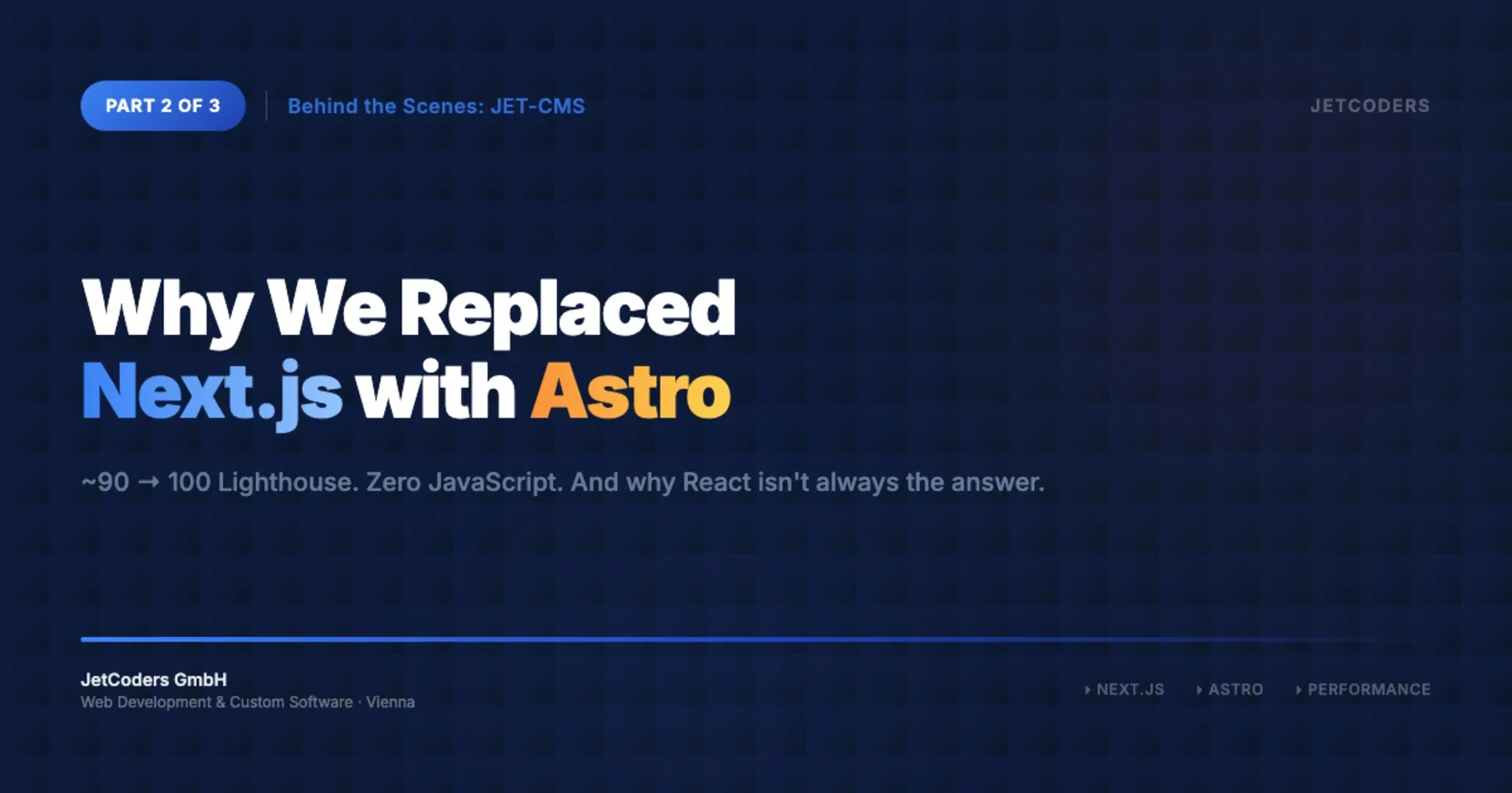
Part 2: Why We Replaced Next.js with Astro
For the last few years, React & Next.js was our go-to. For everything.
JET-CMS public websites ran on Next.js 15 + Chakra UI v3. Performance? A solid ~90/100 Lighthouse.
Not bad. But not perfect either.
The Realization
Then we discovered that ISR is also possible with Astro.
Our CMS websites are content pages: text, images, CTAs. Maybe a FAQ accordion. No complex client-side state. No SPA feel needed.
So we took the leap.
The Result After Migration
- ~90 → nearly 100/100 Lighthouse
- Zero JavaScript by default
- Only load what actually needs to be interactive
Astro ships zero JavaScript to the browser by default. Only when a component actually needs interactivity — a contact form, a FAQ accordion — the necessary JavaScript is loaded.
For content websites, that’s a game-changer.
Next.js Still Has Its Place
Next.js is a fantastic framework. For web apps. For dashboards. For interactive products.
Our CMS admin panel — the interface where customers edit their content — still runs on Next.js. That’s where it makes sense: complex forms, real-time preview, drag-and-drop.
But for the public-facing website? Astro is simply the better choice.
What This Means for Clients
- Best Google PageSpeed scores — proven to be good for SEO
- Faster loading times — especially on mobile devices
- Less resource consumption — good for the environment and the budget
Your Website Deserves the Best Technology
With JET-CMS you get a website that scores 100/100 on Google PageSpeed — and that you can manage yourself. No developer skills needed.
Part 3: Why We Now Use Tailwind with AI
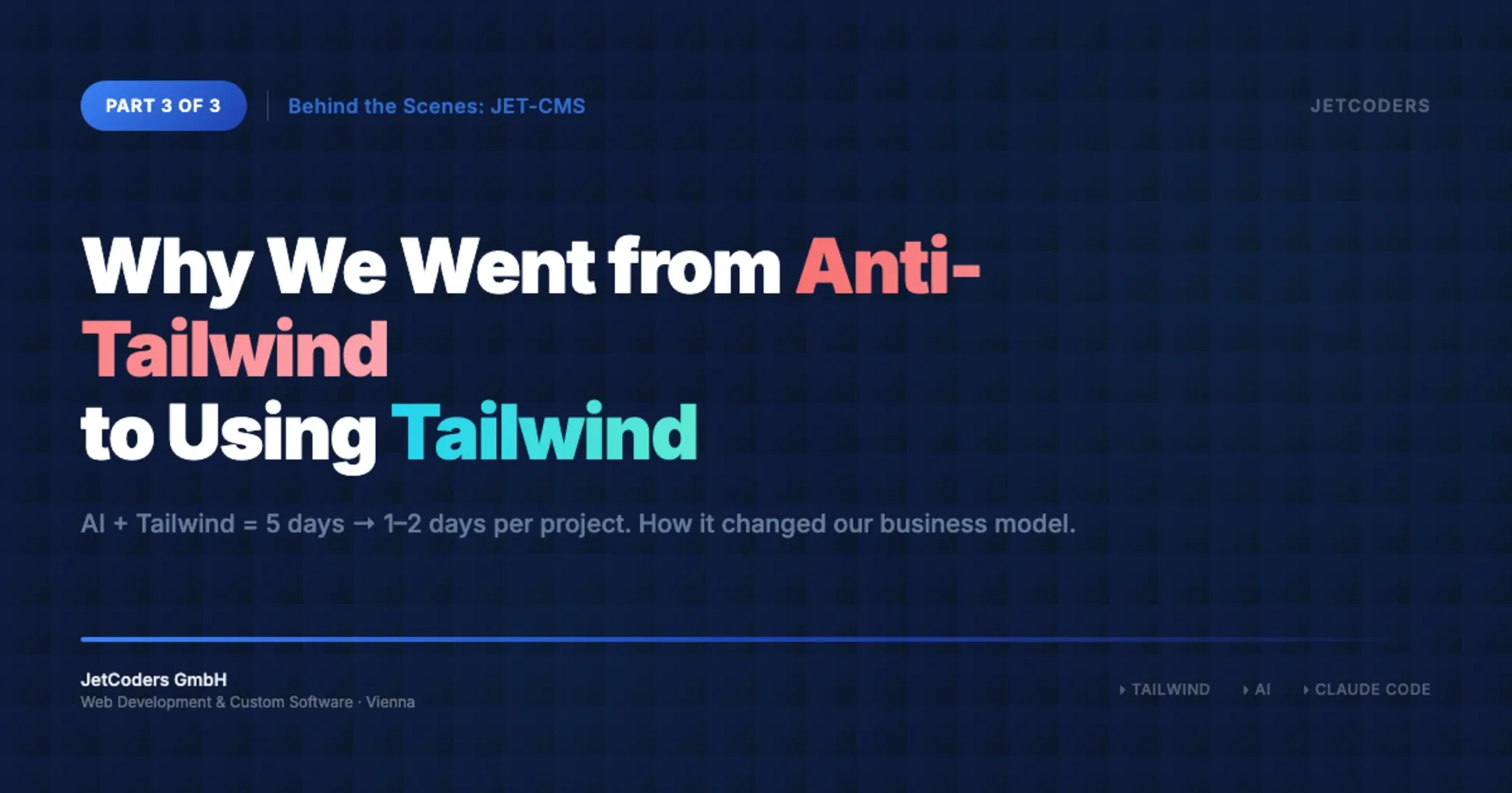
We were anti-Tailwind. Utility class soup in markup? Not our thing.
And yet we’re using it now.
The Problem: Custom Design Takes Time
Every JET-CMS client project gets a unique design. Previously, that meant: about 5 days per project. Implementing designs, making them responsive, building sections, testing.
That’s a lot of time — especially when juggling multiple projects in parallel.
The Solution: AI + Tailwind
Today we get it done in 1–2 days. The workflow:
Step 1 — Create an AI prototype: We have Claude Code create a design prototype. Plain HTML + Tailwind. Responsive. Unique for the customer.
Step 2 — Send directly to the client: No Figma. No “imagine this.” A real, clickable design — with animations and everything.
Step 3 — Build process: We feed the approved HTML + our secret prompt recipe into the build process. The prototype becomes a finished JET-CMS project.
Why This Works
Claude Code writes clean prototypes with Tailwind. No setup. No design system to import. Just HTML + utility classes = done.
Tailwind isn’t the “better” CSS solution here — it’s the language that AI speaks best.
The Business Impact
- 5 days → 1–2 days per project
- 2–3x cheaper for clients
- Scalable as a small team
- Multiple projects in parallel possible
We didn’t change our mind because Tailwind is “better.” We changed it because, combined with AI, it transformed our product and our business model.
Sometimes the best tech decision isn’t the most elegant — it’s the one that lets you deliver value faster.
Unsure About Your Tech Strategy?
We help businesses make the right technology decisions — based on real-world experience, not hype. Let's talk about your project.
What You Can Take Away from This
These three decisions have something in common: they were all uncomfortable. We had to leave tools we knew and loved. We had to rethink opinions we’d held for years.
But they massively improved JET-CMS as a product:
- Faster websites for clients (100/100 Lighthouse)
- Lower costs for hosting and development
- Faster delivery (5 days → 1–2 days per project)
- Better scalability for our team
If you’re planning a custom software project — whether it’s a new website, an MVP , or a complex web application — you benefit from a partner who doesn’t act out of habit, but chooses the best solution for your specific problem based on experience.
Have questions about your tech strategy? Book a free project analysis — we’d love to help.
FAQs
What is JET-CMS?
JET-CMS is a content management system that lets businesses manage their own website — without developer skills. It combines a visual editor with modern web technologies for the best performance and SEO.
Is Astro better than Next.js?
It depends on the use case. For content websites (blogs, landing pages, company sites), Astro is the better choice because it ships zero JavaScript to the browser by default. For interactive web apps, dashboards, and complex SPAs, Next.js remains an excellent choice.
How much does a website with JET-CMS cost?
Thanks to our AI-powered workflow, we can offer custom websites at significantly lower prices than traditional agencies. Contact us for a non-binding quote — the first consultation is free.
Why Cloudflare instead of Vercel for hosting?
Cloudflare offers simple cache invalidation via a single API request, a cost-effective edge CDN, and excellent performance. For content websites that are frequently updated, it’s the more reliable and affordable solution.